Mining in 24 hours or a machine with your name on it
Every miner at Cuverse runs on one of two infrastructures:
Cloud Infrastructure
A unit from our live fleet is allocated to you — mining within about 24 hours, with the rate and every cost locked for the full 36 months, everything included.
Hosting Infrastructure
We purchase your specific machine from the manufacturer, deliver it to the data center, and rack it — it's physically yours, including the option to take it home.
Same data centers, same MAX & ECO modes, same payouts to your wallet — different mechanics where it counts.
01
Start
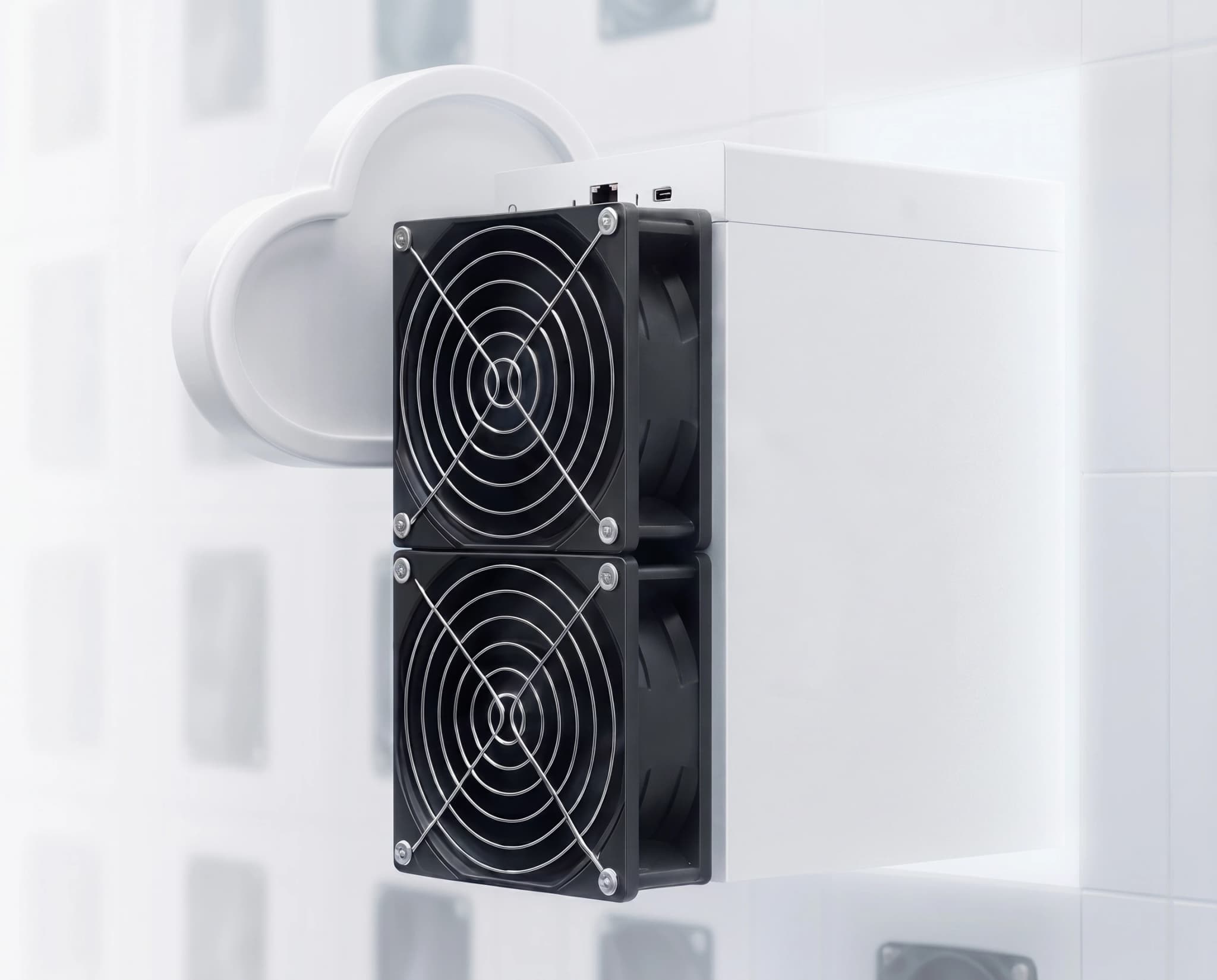
The most visible difference is day one. Hosting Infrastructure begins with logistics — your machine is bought from the manufacturer, shipped, and racked. Cloud Infrastructure skips all of that: the hardware already exists, spinning in our fleet, and gets allocated to you. And weeks of head start aren't abstract — they're mining time.
A typical start
Illustrative. Head start assumes a 245 TH machine at the current network reward (~0.0000005 BTC/day, ≈ $0.04/day at $81,214/BTC) over a five-week procurement window. Hosting Infrastructure lead time depends on the model and current stock — typically up to about five weeks including shipping; if your model is already in the data center, activation can take about 24 hours as well.
By the time a freshly purchased unit comes online, the same money on Cloud Infrastructure has already produced ≈ 0.0042875 BTC (≈ $348.20). Waiting has a price — it's just usually invisible.
02
Side by side
What matters
same DCs, modes, payouts
Hosting Infrastructure
12-month placement
Cloud Infrastructure
36-month placement
Start of mining
Typically up to ~5 weeks
After your unit is purchased & racked, model & stock dependent.
Within ~24 hours
Allocated from the live fleet.
Hosting rate
Locked for the 12-month term
Indexation applies at each renewal.
Locked for the entire 36 months
No revision, no indexation
Warranty
12 months standard
Extended coverage available.
36 months — the full term.
Repair costs
Covered while warranty is active
Outside it, repairs are billed to you.
All included
Warranty spans the whole 36 months, so repairs are never your bill.
Committed uptime
MAX mode, annual minimum
95%
99%
During a repair
Your unit pauses
Fixed on-site in days — no shipping, no queue.
Equivalent capacity covers
Output continues while the unit is fixed.
Delivered hashrate
Your specific machine's output
Dips and drifts a little with age.
The capacity you selected, flat
Delivering it is our job.
At the end of the term
The machine is yours
Trade it in for a newer model, sell it to us at market price, extend — or take it home.
A machine is yours here too
An equivalent unit from the fleet: trade in, sell to us at market price, or extend; it just doesn't ship.
Built for
Owning a specific box
With the freedom to take it away.
Starting today
With every cost and coverage fixed for three years.
What indexation quietly costs
The rate lock isn't cosmetic. On Hosting Infrastructure the rate resets at each yearly renewal — say a modest 3.5% indexation. Same machine, same three years, same starting rate: the indexed path pays about $257 more for energy than the locked one. Nothing broke, nothing changed — that's just what "revised at renewal" compounds into. On Cloud Infrastructure the number you signed is the number you finish with.
3-yr energy, indexed +3.5%/yr
$7,500
3-yr energy, locked all 36 mo
$7,243
Kept by the lock
≈ $257
03
The honest trade-offs
What Hosting Infrastructure asks of you
- Patience at the start — purchase and shipping take real weeks unless your model is in stock.
- Terms reset yearly — the rate is locked for 12 months, then indexation applies at renewal.
- Repairs can become your bill — covered while the warranty runs; outside it, they're on you.
- Repairs pause your unit — days, not weeks, but the machine assigned to you is the machine that mines.
- In exchange: it's your specific box — trade it in, sell it to us, or physically take it home at the end of any term.
What Cloud Infrastructure asks of you
- A three-year horizon — the placement runs 36 months, and that commitment is exactly what buys the lock.
- No specific box to ship home — your machine is an equivalent unit from the fleet; at the end you trade in, sell to us, or extend, but it doesn't ride in a courier van.
- In exchange: mining within ~24 hours, a rate that can't move for three years, no indexation, 99% committed uptime, warranty and repairs included for the whole term, and output that doesn't pause when hardware is fixed.
New and undecided? Cloud Infrastructure is the simpler default — instant start, everything included, nothing to revisit for three years. Hosting Infrastructure is there when owning the specific box matters. And plenty of clients simply run both.
04
Which fits you?
Four questions, honestly mapped. This isn't advice — just your own preferences, reflected back.
Do you want to physically hold the machine — and be able to take it home?
When do you want to start mining?
What's your planning horizon?
If a unit needs repair?
Answer the questions
- Each answer nudges the needle — there are no wrong ones.
Comparing with a garage instead?
Fair fight — so count everything: residential electricity rates, industrial noise and heat in a living space, and every failure becoming your own shipping-and-waiting project (typically weeks of lost mining per incident, versus days or hours here). We've drawn that comparison honestly, timeline and all, on the uptime & protection page.
05
Same on both – the platform layer
Whichever infrastructure you pick, the rest of Cuverse works identically underneath.
MAX & ECO modes
Two ways to run the same hardware — switch as the market moves.
Payouts to your wallet
Pool → your address, on your schedule. We hold no keys, no coins.
Monitoring & protection
24/7 telemetry, on-site engineers, repairs meters from the rack.
Loyalty cashback
Tiers reduce your effective energy cost on both infrastructures.
06
FAQ
- They optimize for different things. Hosting Infrastructure maximizes possession: a specific machine that's yours to take away, with terms reset yearly. Cloud Infrastructure maximizes speed and certainty: mining in about a day, with the rate, warranty, repairs, and uptime commitment fixed across three years — which is why it's the default we suggest when someone's undecided. The fit-finder above maps your own preferences.
- Because nothing needs to be bought or shipped. The hardware already exists and is already running in our fleet — activation is an allocation, not a logistics project. Hosting Infrastructure starts with purchasing your specific machine from the manufacturer and delivering it, which takes real-world weeks unless the model is in stock at the data center.
- In both cases — yes. The difference is which machine. On Hosting Infrastructure it's one specific, serial-numbered unit, and you can physically take it home. On Cloud Infrastructure your machine is an equivalent unit from the shared fleet — the same model and capacity, just not one particular box, and it stays in the data center. The exact title terms for each placement are set out in your agreement.
- Flexibly, in both cases. You can trade the machine in toward a newer, more efficient model, sell it to us at market price, or extend the placement. On Hosting Infrastructure there's a fourth option: have it shipped to you (at your cost). If you take no action on Hosting Infrastructure, the unit is kept in storage for a daily fee until you decide; on Cloud Infrastructure there's nothing to arrange — the unit simply stays in the fleet.
- On Cloud Infrastructure — yes: the hosting rate is locked for the entire 36-month term. No mid-term revision, no indexation. On Hosting Infrastructure the rate is locked for the current 12-month term, and indexation applies when you renew. The panel above shows what that difference compounds into over the same three years.
- On Cloud Infrastructure — never you: warranty spans the full 36 months, and repairs are part of the service, with equivalent capacity covering your output meanwhile. On Hosting Infrastructure, repairs are covered while your warranty is active (12 months standard, extendable); outside coverage, repairs are billed to you. Routine maintenance to manufacturer requirements is included in both.
- Yes — both infrastructures support both operating modes, per device, and you can switch as the market changes. The economics of when to run which are covered on the MAX & ECO page.
- In both placements, monitoring catches it in minutes and repair happens on-site — no shipping, no third-party queue. The difference: on Cloud Infrastructure, equivalent capacity from the fleet covers your output while the unit is fixed; on Hosting Infrastructure, your specific machine pauses for the on-site repair — days, not weeks. The full picture is on the uptime & protection page.
- Yes, and many clients do — owned machines on Hosting Infrastructure alongside Cloud Infrastructure capacity for the locked economics. Each device carries its own placement, mode, and terms, all managed from the same dashboard, with the same payouts to your wallet.
- Placements aren't converted mid-term — each runs on its own agreement. The natural switching point is the end of a Hosting Infrastructure term, when everything is up for decision anyway; and you can add a placement of the other type at any time.

Start where the fleet is already spinning
Cloud Infrastructure gets you mining in about a day, with three years of locked terms — and Hosting Infrastructure is one click away when owning the box matters.
About this page. A simplified comparison as of the page date. Activation and delivery timelines are illustrative and depend on model availability, logistics, and data-center stock; 'within ~24 hours' refers to allocation of available fleet hardware and is not a guaranteed activation time in every case. The head-start figure assumes a 245 TH machine at the current network reward of about 0.0000005 BTC per TH per day over a five-week window; the indexation panel assumes an illustrative 3.5% annual indexation, a 3.675 kW machine in MAX mode, and an effective energy rate of $0.075/kWh after top-tier loyalty cashback — actual rates, rewards, indexation, and the $81,214/BTC reference all vary. Hosting rates, terms, warranty and repair coverage, uptime commitments (including the annual MAX-mode minimums of 95% for Hosting Infrastructure and 99% for Cloud Infrastructure), capacity-replacement mechanics, end-of-term options (trade-in, buyback, extension, shipping) and any storage fees are set out in, and governed by, your agreement and its annexes and the current terms on cuverse.com — where this page and those documents differ, the documents prevail; buyback and trade-in are agreed case by case at then-current market terms. ECO mode follows its own scheduled uptime targets. Nothing here is an offer, advice, or a guarantee of any result.